Fermentation and Gel Setting in Enzyme Jelly OEM: From Cycle Time to Gel Strength
Enzyme jelly merges palatability and function more neatly than almost any other format. The jelly form is inherently snackable and portable, while the enzyme concept carries its own health halo. It is also one of the longer contract manufacturing chains, since both the fermentation stage and the gel setting stage have to be controlled.
Three Sources of Enzyme Material
The first is in-house fermentation: fruit, vegetable and medicine-food homology substrates are inoculated with yeast, lactic acid bacteria or acetic acid bacteria for a multi-stage fermentation typically running 3 to 12 months. The advantage is a strong product story built on a proprietary fermentation process. The drawbacks are long tank occupancy, difficulty holding batch-to-batch consistency, and heavy demands on culture management and process control.
The second is purchased enzyme concentrate or powder, supplied by a specialist and used by the manufacturer for blending and setting. Lead time is short, stability is good and cost is controllable, at the expense of a weaker story. Most enzyme jelly OEM programmes take this route.
The third is compounded enzyme preparations: adding protease, lipase, amylase, cellulase or blends of purified enzymes rather than a fermentation product. Activity is quantifiable and the mechanism is clear, but the fermentation narrative weakens, and enzyme proteins are sensitive to both heat and pH.
Key Fermentation Parameters
Where in-house fermentation is chosen, five variables govern the outcome: the culture combination, since multi-strain fermentation usually delivers richer flavour than a single strain; inoculation rate; fermentation temperature, most often between 25 and 37 degrees Celsius; cycle length; and the termination point, judged on pH, sugar content, total acidity or a specific metabolite level. After fermentation the broth is filtered, standardised, and if necessary concentrated or dried to powder. One point is routinely missed: fermentation broth tends to be quite acidic, and adding it directly to a jelly system disrupts gelation, so pH adjustment is mandatory first.

Hydrocolloid Systems and Setting
Jelly gel systems are almost always blends. Carrageenan with konjac gum is the classic pairing, balancing elasticity against water holding. Carrageenan with locust bean gum gives a softer, springier bite. Where a vegan claim or a specific texture is needed, pectin or gellan gum can replace part of the system. Gellan works at very low use levels, 0.05% to 0.1%, with excellent clarity but a higher cost.
The setting sequence runs as follows: dissolve the gel by dry-blending hydrocolloids with sugar, adding water and heating to 80 to 95 degrees Celsius until fully hydrated; adjust pH and add flavour by cooling to 70 to 80 degrees Celsius and introducing acidulants, flavours and colours, taking care to acidify at reduced temperature to avoid hydrolysing the gum; add heat-sensitive actives below 60 degrees Celsius, including enzymes, probiotics and vitamins; fill and seal; pasteurise, typically at 80 to 85 degrees Celsius for 15 to 30 minutes; then cool to set.
This order cannot be rearranged. Adding acidulant too early, or adding it while the batch is still hot, hydrolyses the carrageenan and collapses gel strength, leaving the finished product as flavoured water rather than jelly.
Protecting Enzyme Activity
Here lies the central technical contradiction of enzyme jelly. Enzymes are proteins that denature irreversibly above 60 to 70 degrees Celsius, while jelly production requires both high-temperature dissolution and pasteurisation. Three solutions exist. The first is to lower the terminal sterilisation profile to a lower temperature held longer, combined with tighter in-process hygiene. The second is to add the enzyme in microencapsulated form for improved heat tolerance. The third is post-addition, introducing sterile enzyme concentrate immediately before filling. The three escalate in cost, so the choice follows product positioning and price band.
Five Common Quality Defects
Insufficient gel strength, showing as soft product or free water, comes from under-dosing hydrocolloid, acidifying too early or at too low a pH, or failing to reach full dissolution temperature so the gum never fully hydrates.
Syneresis, or weeping, indicates an unbalanced hydrocolloid ratio, wide storage temperature swings, or a high fruit juice load destabilising the system.
Bubbles and cloudiness result from air entrained during dissolution without a deaeration step, filling too fast, or inadequate filtration of the batch.
Microbial exceedance follows from an insufficient pasteurisation profile, a poor seal, or loss of hygiene control in the filling environment. Jelly is rich in sugar and water, so contamination readily ferments and gasses.
Flavour deterioration appears as cooked notes from excessive heat, a poorly chosen flavour system, or odour migration from packaging. Run packaging compatibility testing, particularly on the inner liner of spouted pouches and plastic cups.
Related Products
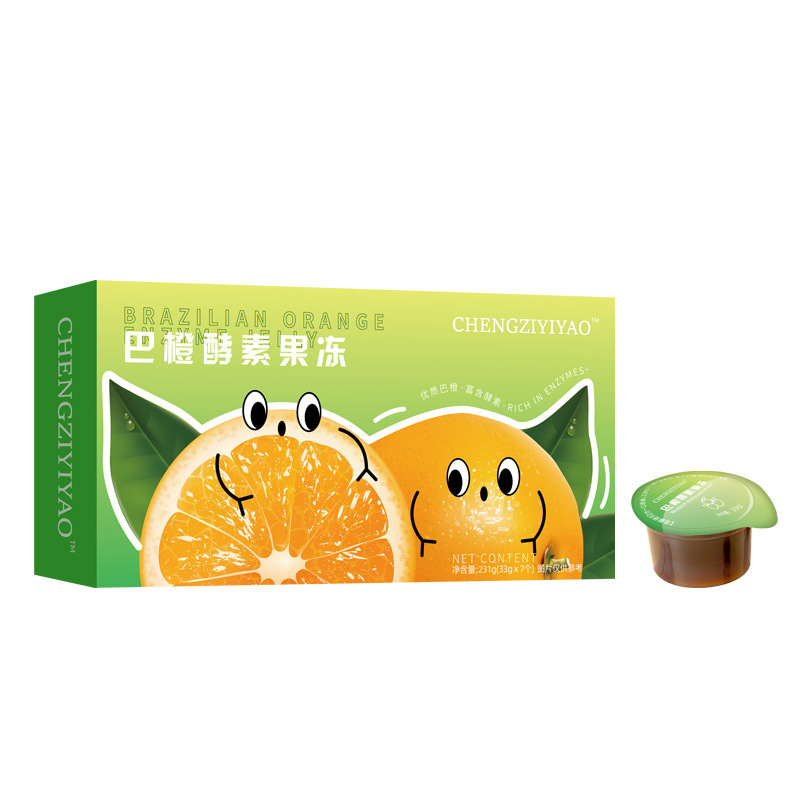
Extra Strength Orange Enzyme Jelly with Prebiotics | Fruit-Flavored Cup Jelly Private Label OEM Manufacturer | Collagen Fruit & Vegetable Enzyme Jelly with Prebiotics | Custom Extra Strength Jelly OEM Factory
About Guangzhou Mesen Health Biotechnology Co., Ltd
Guangzhou Mesen Health Biotechnology Co., Ltd is located in the Huashan Science and Technology Park, Huadu District, Guangzhou. The company has focused on OEM and ODM services for the big health industry for nearly 20 years, operating dedicated research, production, sales and management centres, and maintaining long-term strategic partnerships with well-known Chinese medicine colleges and research institutions. Capabilities span pressed candy, gummies, capsules, solid beverages, herbal teas, plant beverages, protein powders, dietary supplements and enzyme jelly - from formulation development through contract manufacturing. For details on minimum order quantities, sampling lead times and quotations, see our manufacturing advantages and product range, or contact us for a tailored proposal.
Further Reading