Plant Beverage Packaging in OEM: PET, Glass, Cartons and Cans Compared
Plant beverage projects tend to pour effort into sterilisation parameters and stabiliser systems, then discuss packaging last. The result is a formula that is already fixed, squeezed into whichever container happens to be available, with a shelf life and channel that do not match. In plant beverage contract manufacturing the container is an upstream variable. Oxygen transmission sets how fast oxidation proceeds, light transmission sets how quickly colours and vitamins fade, the seal structure sets microbial risk, and pressure tolerance decides whether a sparkling version is even possible. This article puts the four mainstream containers side by side and offers a way to work backwards from channel and shelf life.
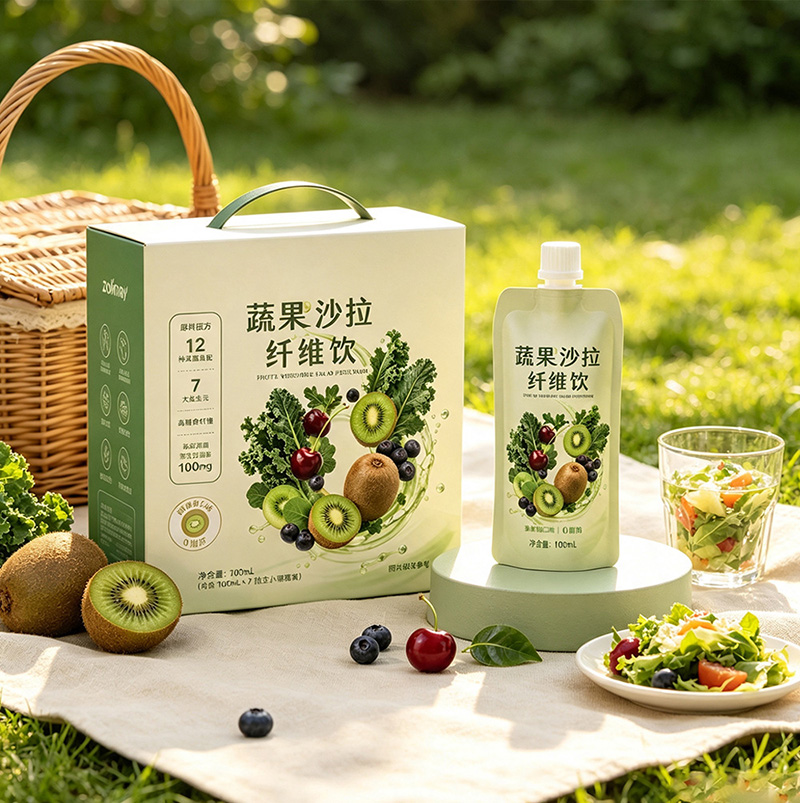
PET bottles: versatility with a barrier gap
PET is the default for ready-to-drink products. Cost is moderate, the material is clear and light, it resists impact, and it takes almost any bottle shape or neck finish, with tamper bands and sports caps easy to add. Its weakness is oxygen and light barrier. Standard monolayer PET transmits enough oxygen that, as storage time and temperature rise, sensitive contents suffer - particularly formulations with unsaturated fats, vitamin C or polyphenols. There are three ways to reinforce it. Adding wall thickness and weight helps a little at real cost. Co-injection or blending in a barrier material works noticeably better but needs coordination with the bottle maker. A full-wrap or shrink sleeve label solves the light problem cheaply. Decide first whether the product is short-life chilled or ambient long-life; the two call for entirely different bottle weights and barrier configurations.
Glass: best barrier, heaviest cost structure
Glass gives the best oxygen and light performance of any container. It is chemically inert, does not migrate, tolerates repeated high-temperature processing, and suits long shelf life and formulations where flavour and colour matter - as well as premium positioning. The costs are just as clear: weight drives freight up, breakage drives protective packaging and handling costs up, bottle development and moulds require investment, and line speed is limited. Selection work centres on matching the neck finish to the closure system and confirming heat resistance against the filling and sterilisation process. For carbonated products glass is among the safer choices, but pressure tolerance and breakage protection need evaluating. Commercially, glass usually depends on a short distribution radius.
Aseptic cartons: cost and sustainability together
An aseptic carton is a laminate of paperboard, aluminium foil and polyethylene. The foil layer delivers the critical oxygen and light barrier, and combined with aseptic filling it reaches ambient long shelf life. Barriers approach metal performance, unit cost is low, transport and storage are efficient, the printable surface is large, and the sustainability story is easy to tell. The constraints are real: aseptic filling capability is mandatory, which constrains equipment and plant qualification; dependence on the carton supplier is high; and shelf presence is weaker than a transparent bottle. Shapes are limited too - brick and square formats dominate, with little bottle freedom. Cartons suit ambient distribution, e-commerce and family formats, especially for oxidation-sensitive products such as grain and nut beverages.
Metal cans: the strongest barrier, with trade-offs
Aluminium and tinplate cans give the best oxygen and light barrier, complete light exclusion, reliable sealing and good pressure tolerance. They suit carbonated products and long shelf life, chill quickly, and stand out on shelf. Two things need attention. Compatibility between contents and metal is one: acidic plant beverages depend on an internal coating, which makes coating integrity a critical control point. The other is consumption behaviour - once opened, a can must be finished, which is awkward for large single-serve formats. Slim cans have become a strong trend, and many plant beverages that once shipped in bottles now use them to reinforce an on-the-go and social character. Those projects turn on matching can format to filling equipment and validating coating compatibility with the contents.
Working backwards from channel and shelf life
Rather than choosing a container then discovering the shelf life, reverse the order. Start with channel and shelf life: chilled short-life, ambient six months, or ambient twelve months plus. Those three bands eliminate whole categories on their own. Next, establish how oxygen and light sensitive the contents are. Formulations with polyphenols, unsaturated fats, vitamin C or natural colours should be pushed towards high-barrier options. Third, define the occasion: single-serve on the go, multi-serve at home, or office use. Capacity and opening style follow from that. Fourth, cost the whole system - container, closure, label, transport protection and breakage - not the unit price of the empty container. Fifth, run physical validation: fill real containers, run accelerated storage and a genuine transport test, and base the decision on data rather than instinct.
Validation and the usual traps
Once the container is chosen, three studies are mandatory. Compatibility, confirming that contents do not migrate into or adsorb onto the container or internal coating. Seal integrity, covering cap torque, seal completeness and condition after transport vibration. Shelf life, tracking sensory quality, colour, sediment and key actives under both accelerated and ambient conditions. Three traps recur. Treating a passing microbiological result as proof of shelf life, while ignoring oxidation and colour shift. Choosing containers on unit price and losing the difference to freight and breakage. And overlooking the neck-to-closure match until leakage or unstable torque shows up in production. Close those three out at the sampling stage and the container becomes part of the product's competitiveness.
A container is not packaging. It is part of the formulation. It decides how long the product can last, which channels it can enter and how a consumer picks it up. Work through channel, sensitivity and full-system cost, then close with compatibility, seal and shelf-life validation. Packaging stops being a leftover choice and becomes the first step in defining the product.
Related Products
Milk Thistle, Kudzu & Turmeric Beverage with Sea Buckthorn Puree & Honey | Herbal Oral Liquid OEM | Liquid Fruit & Vegetable Salad Fiber Drink | Dietary Fiber Meal Replacement Vegetable Juice Beverage OEM
About Guangzhou Mesen Health Biotechnology Co., Ltd
Guangzhou Mesen Health Biotechnology Co., Ltd is located in the Huashan Science and Technology Park, Huadu District, Guangzhou. The company has focused on OEM and ODM services for the big health industry for nearly 20 years, operating dedicated research, production, sales and management centres, and maintaining long-term strategic partnerships with well-known Chinese medicine colleges and research institutions. Capabilities span pressed candy, gummies, capsules, solid beverages, herbal teas, plant beverages, protein powders, dietary supplements and enzyme jelly - from formulation development through contract manufacturing. For details on minimum order quantities, sampling lead times and quotations, see our manufacturing advantages and product range, or contact us for a tailored proposal.
Further Reading