Stability Testing for Oral Liquid OEM: Accelerated and Long Term
A shelf life for an oral liquid cannot be asserted from experience; it has to rest on stability data. Unlike a solid, an oral liquid is a solution system where hydrolysis, oxidation, photolysis and physical settling all operate at once, interactions between ingredients are more active, and any factor left out of the plan can surface mid-shelf as sediment, colour shift, pH drift or falling assay. These problems also accumulate slowly: two weeks at room temperature look perfect, six months later the change is obvious. The stability plan therefore belongs at the sampling stage, not in a rush just before launch. In dietary supplement oral liquid contract manufacturing, stability data underpins both formula lock-in and packaging selection. This article covers failure types, test conditions, endpoints, packaging compatibility, data reading and retention management.
The five ways an oral liquid fails
Failure falls into five groups. Chemical degradation covers hydrolysis, oxidation and photolysis of actives - hydrolysis is strongly pH-dependent, oxidation depends on dissolved and headspace oxygen, and photolysis tracks the light barrier of the pack. Physical instability shows up as sediment, separation, haze or crystallisation, and in suspension products as settling with poorer redispersibility. Sensory change includes darkening or fading, odour shift, and taste turning bitter or astringent; even with assay in specification, consumers read these as spoilage. Microbial risk depends on the effectiveness of the preservative system and the integrity of the seal. Packaging-related change includes bottle deformation, label lift, liner swelling and leachables. Listing all five is what keeps the test panel complete.
Setting the conditions
A conventional plan runs several condition sets. Accelerated testing at elevated temperature and humidity exposes latent problems quickly and is used to compare formulas and packaging options. Intermediate conditions support the case when accelerated results show significant change. Long-term testing at conditions close to real storage confirms the shelf life. Product-specific conditions are added as needed: light exposure studies for photosensitive formulas, low-temperature and freeze-thaw cycling for products that will travel through cold regions, and oxygen and moisture transmission assessment for plastic containers. Every condition should state temperature, humidity, light intensity and sampling points in the protocol, so execution stays consistent across batches.
Endpoints and testing frequency
Endpoints must cover the five failure groups, adjusted for the product. Universal items include appearance and colour, odour, pH, assay, related substances or degradation products, microbiological criteria, fill volume and seal integrity. Suspension products add sedimentation volume ratio and redispersibility; products containing oils or oxidation-prone actives add peroxide value or a specific oxidation marker. Frequency is usually front-loaded: dense sampling early to catch fast change, wider intervals later. Endpoint choice must also connect to what the product claims. If a specific ingredient content is claimed, that ingredient's stability needs its own evaluation. If a taste characteristic is claimed, sensory evaluation belongs in the panel rather than analytical testing alone.
Linking the packaging compatibility study
Oral liquid stability is tightly coupled to packaging, so the compatibility study belongs alongside stability testing, not after it. For glass, watch the hydrolytic resistance of the inner surface: prolonged contact with alkaline or high-ionic-strength solutions can leach alkali and drive pH up. For plastic, watch oxygen and moisture transmission and the migration of plastic additives into the contents. For metal closures and liners, watch coating integrity and liner swelling. A good design fills the same formula into two or three candidate packs and runs them in parallel under identical conditions, which delivers formula data and a direct packaging comparison at once. If one pack degrades clearly faster, the swap can happen before lock-in instead of being forced after launch.
Reading the data and estimating shelf life
Reading starts with defining significant change, then trends. Significant change typically means assay falling below the specified limit, related substances exceeding a limit, pH outside the specified range, unacceptable sediment or colour change, or a failed microbiological result. Do not judge only whether a single timepoint is out of specification - look at the rate. If a parameter moves monotonically up or down, the rate can be extrapolated to judge whether it still passes at the end of the target shelf life. Accelerated results are good for comparison and screening, but using them to calculate long-term shelf life directly needs care: reactions differ in temperature sensitivity, and the degradation route dominating at high temperature may not be the main one at ambient. The sound approach is to base the claim on long-term data and use accelerated data as support and early warning.
Retention samples and post-market monitoring
When the stability study ends, retention management begins. Keep enough samples per batch, with part stored under conditions matching real storage for annual review and part under stricter conditions for comparative analysis when problems arise. Log batch, production date, retention date and storage conditions, and link them to the batch record so a query can trace back to the raw materials and process parameters of that lot. After launch, set up monitoring: collect market feedback on sediment, colour and taste, compare it against retention re-evaluation, and decide whether an issue is batch-specific or systemic. For a product made every year, run an annual data review to confirm the formula and process are still stable after long running. That turns shelf life from a one-off test result into a continuously controlled parameter.
Oral liquid stability is not settled by a single study. It is the joint product of formula, process, packaging and storage conditions. List the failure modes completely, run multiple conditions in parallel, complete packaging selection through the compatibility study, define significant change and read trends to reach a defensible conclusion, then hold it with retention samples and post-market monitoring. For a contract manufacturing project, that dataset is both the basis of the shelf-life statement and the most convincing answer when a customer asks.
Related Products
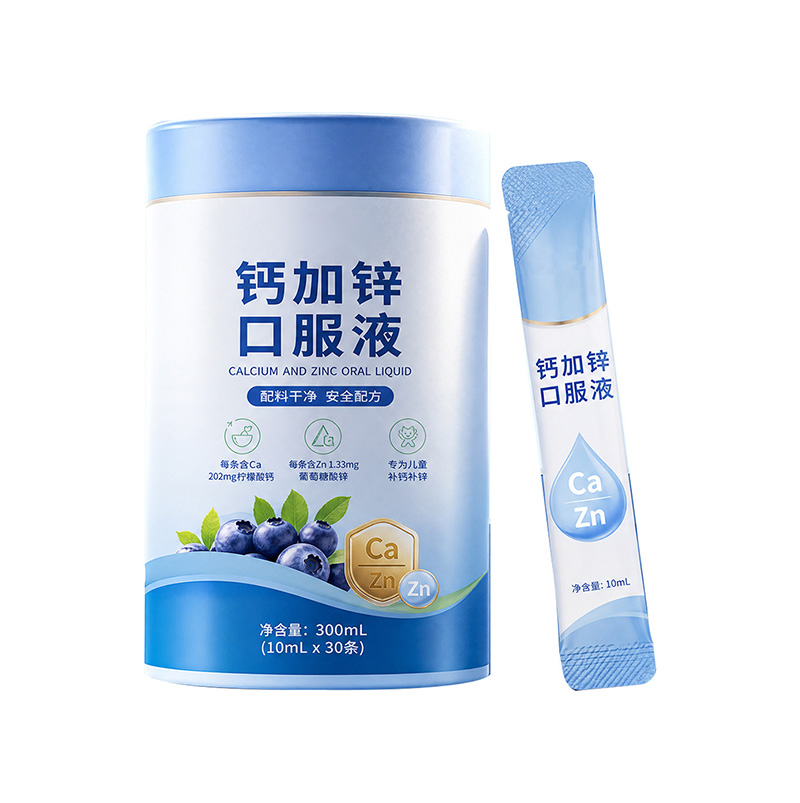
Calcium + Zinc Oral Liquid Blueberry Flavor | Zinc Gluconate Liquid Calcium Supplement for Kids OEM | Kids Liquid Calcium with High-Potency Vitamin K2 & D3 | Calcium Zinc Oral Liquid for Teens OEM
About Guangzhou Mesen Health Biotechnology Co., Ltd
Guangzhou Mesen Health Biotechnology Co., Ltd is located in the Huashan Science and Technology Park, Huadu District, Guangzhou. The company has focused on OEM and ODM services for the big health industry for nearly 20 years, operating dedicated research, production, sales and management centres, and maintaining long-term strategic partnerships with well-known Chinese medicine colleges and research institutions. Capabilities span pressed candy, gummies, capsules, solid beverages, herbal teas, plant beverages, protein powders, dietary supplements and enzyme jelly - from formulation development through contract manufacturing. For details on minimum order quantities, sampling lead times and quotations, see our manufacturing advantages and product range, or contact us for a tailored proposal.
Further Reading