Dual-Chamber Stick Packs for Powder OEM: Keeping Actives Apart
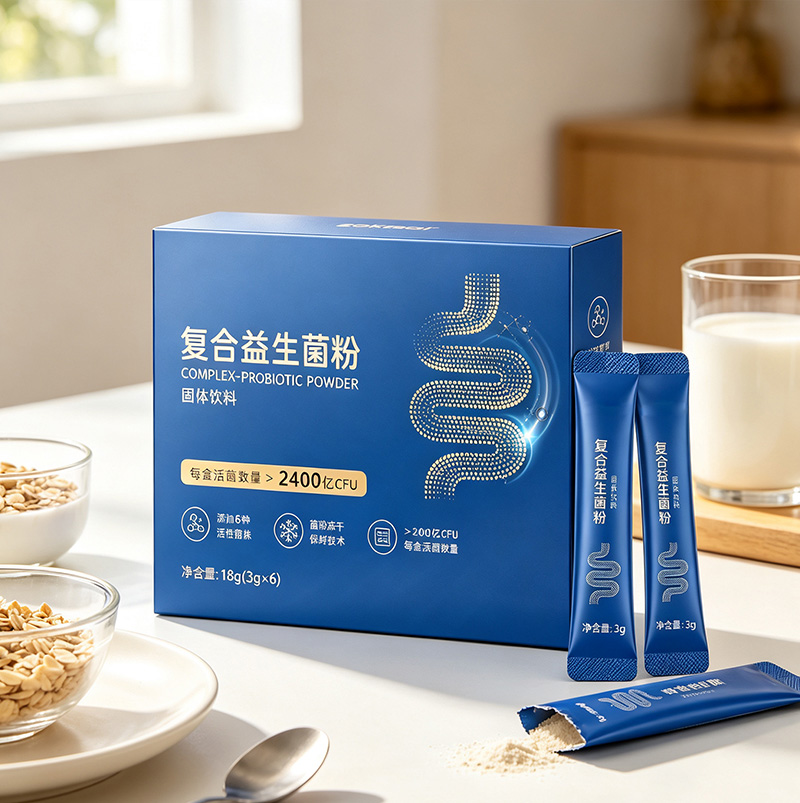
When clients brief a solid beverage contract manufacturer, they usually describe the benefit and the flavour first, and reach packaging last. In one situation, however, packaging has to be settled early: when the formula contains ingredients that cannot sit together for long. The clearest example is probiotics alongside minerals, since mineral salts raise ionic strength as soon as traces of moisture appear and directly reduce cell survival. Acids with bases behave similarly, reacting slowly whenever a little moisture is present, so that effervescence performance has visibly declined after a few months. Active extracts blended with concentrated spray-dried flavours suffer too, because solvents and aldehydes in the flavour accelerate oxidation of the active. Desiccants or a better film only mitigate such conflicts. The clean answer is to fill the components into separate compartments of one pack.
1. Which combinations warrant separate compartments
Two tests decide it: whether the components react chemically or physically when co-located, and whether the reaction is slow enough to be tolerable over a normal shelf life. Applied consistently, four groups emerge. Live cultures with high ionic strength ingredients, including mineral salts and some electrolytes. Acid and base pairs, classically the acid and base sources of an effervescent system, and sometimes acidic flavours with alkaline raw materials. Oxidation-prone actives with metal-bearing ingredients, iron, copper and manganese in particular. And components whose moisture affinities differ sharply, one strongly hygroscopic and the other moisture-sensitive, where co-location drives local moisture migration until both are damaged. Where two components merely taste odd together, or simply differ enough in bulk density to segregate during blending, that is a process issue rather than a packaging one.
2. How compartments are built in practice
Three designs are common. The true dual-chamber stick pack forms two sealed cavities when a longitudinal barrier is creased into the film, which requires a filler with two dosing stations and a sealing station that forms the barrier and closes both ends. Twin connected sachets, or two pouches combined into one retail unit, are the simplest engineering answer but weaken the tear experience and appearance. The third is a main chamber with a small attached pouch or capsule compartment that releases on squeezing, suited to potent ingredients used in tiny amounts. Cost and line requirements fall in that order, and the choice depends on how close the two doses are in size: if one side is twenty grams and the other 0.3 grams, the compartments become so imbalanced that filling accuracy actually suffers, and an attached pouch performs better.

3. Filling accuracy is the real difficulty
A single-chamber stick pack needs only total weight controlled. A dual-chamber pack needs each compartment controlled, with tolerances set as a percentage of each nominal dose, which raises the machine requirement a level. The absolute tolerance for a small compartment is tiny: at 0.3 grams with a ten percent limit, that is thirty milligrams either way, which ordinary auger dosing struggles to hold repeatably. The usual answers are volumetric dosing with servo control, or diluting the minor component into a premix so the absolute quantity handled by the machine grows. Barrier formation is the second difficulty. Too little pressure and the two sides communicate; too much and the film is crushed through, causing leakage. Heat seal temperature, pressure and dwell must be defined as a process window and verified on a schedule. Seal integrity at the transverse and longitudinal seams, and the cut depth of the tear notch, belong in the same validation.
4. Film choice brings a second layer of control
Compartments address interactions between ingredients; the film addresses the outside environment. Stick pack laminates are normally multi-layer, with an aluminium foil layer giving the best moisture and oxygen barrier, though foil can develop pinholes on folding, which the sealant and print layers must compensate for. For products containing live cultures, water vapour transmission rate becomes the governing specification, normally held very low and supported by accelerated testing that demonstrates viable count retention to end of shelf life. Light protection also matters, since some botanical extracts are sensitive to ultraviolet and short-wavelength visible light, where foil structures retain an advantage. Once the film specification is fixed, seal integrity, WVTR and transport drop testing all need to be completed rather than judged by static laboratory observation.
5. The practical costs of compartment packaging
Three costs should be understood up front. Film cost rises, because dual-chamber structures need additional forming operations and generate more waste, so unit cost sits clearly above single-chamber. Throughput falls, since twin-station fillers generally run slower than single-chamber machines and take longer to change over, which affects scheduling in plants running many small batches. Minimum order quantities rise as well, because compartment products need dedicated film reels and tooling, and suppliers impose minimum run lengths, which is real pressure on a first trial order. Before committing, it is worth arguing the opposite case: if controlling raw material moisture, switching to less reactive ingredient forms or adding a suitable buffer resolves the shelf-life problem, conventional packaging is the more economical answer.
6. Settling the design with the manufacturer
The sensible sequence starts with a small-scale co-storage study: blend both components at the real ratio, place them under accelerated conditions and test key parameters on a schedule, using the data to establish whether the conflict is genuine and how severe it is. That determines whether compartments are needed and how many. Next comes a feasibility check on dosing, running the actual materials on candidate equipment and characterising the weight distribution in each compartment. Only then are film and stability validation finalised. The step most often skipped is the first, with clients deciding on experience that two ingredients cannot coexist and paying for compartments unnecessarily. Two weeks of bench work is usually cheaper than changing packaging afterwards.
Related Products
White Kidney Bean Black Coffee Latte Powder | Instant Keto Enzyme Coffee Solid Beverage OEM Private Label | Protein Berry Meal Replacement Shake Powder | Satiety Smoothie Solid Beverage Custom OEM
About Guangzhou Mesen Health Biotechnology Co., Ltd
Guangzhou Mesen Health Biotechnology Co., Ltd is located in the Huashan Science and Technology Park, Huadu District, Guangzhou. The company has focused on OEM and ODM services for the big health industry for nearly 20 years, operating dedicated research, production, sales and management centres, and maintaining long-term strategic partnerships with well-known Chinese medicine colleges and research institutions. Capabilities span pressed candy, gummies, capsules, solid beverages, herbal teas, plant beverages, protein powders, dietary supplements and enzyme jelly - from formulation development through contract manufacturing. For details on minimum order quantities, sampling lead times and quotations, see our manufacturing advantages and product range, or contact us for a tailored proposal.
Further Reading