Herbal Tea OEM Particle Size: Cutting, Crushing and Extraction Yield Trade-Offs
In herbal tea projects the formula gets discussed endlessly, while the particle size column often carries a single word, cut or milled, and nothing more. Yet particle size is the first variable a consumer experiences. The same blend presented as whole leaf, cut leaf or coarse crush can differ sharply in infusion colour, speed of aroma release and how much active material actually reaches the cup. It also feeds back into the packing line: too high a fines fraction produces cloudy infusions, powder migration through the filter paper, and powder on the seal area that weakens the closure. None of that is obvious at trial scale and all of it appears at volume. On herbal tea programmes we treat particle size as a process with parameters to be designed, not a default setting.
1. The processing options
Herbal material is generally handled in five grades. Whole leaf or whole flower, essentially as harvested, used where visual appeal matters, as with flowering teas and premium leaf grades; it infuses slowly but stands up to repeated brews and looks good in the cup. Cut, where leaf and stem are reduced to roughly 5 to 10 millimetres, the most common and safest form for tea bags. Coarse crush at 2 to 5 millimetres, typical for fruits and roots, which infuse noticeably faster. Milled, passing a 20 to 60 mesh screen, used where fast extraction is needed or where the material will be extracted downstream. And micronised or wall-broken powder down to tens of microns, reserved for spore powders and high-value materials where the point is to rupture cell walls and improve bioavailability. Finer is not automatically better. Each grade suits particular materials and occasions, and choosing the wrong one costs more than choosing an expensive one.
2. How particle size drives extraction
Infusion is solvent carrying soluble material out of plant cells, and the rate is governed by three things: contact surface area, diffusion path length and steeping time. Smaller particles mean greater specific surface, more contact with the solvent, and a shorter path from the interior of the cell to the surface, so extraction speeds up. That is why milled material can produce a strong colour in three minutes while whole leaf may need eight to ten. There is a reverse side that gets overlooked. Faster extraction also pulls out material you did not want: astringent compounds from some roots, fibre breakdown products from leaf, producing the familiar result where the tea is quick but unbalanced. Volatile aromatics are lost heavily during milling, and the finer the grind and the higher the milling temperature, the greater the loss. Particle size is therefore a balance between extraction efficiency and flavour integrity, not a race to the finest grind.

3. What fines actually cost you
Fines are the by-product most worth controlling. Cloudy infusion: very small particles stay suspended rather than settling, and consumers read that as haze even when the analysis is fine. Powder through the filter: the pore size of the filter paper has to suit the particle distribution, and above a certain fines fraction the powder either passes through or forms a dense layer on the surface that blocks flow, giving a bag that will not brew. Seal contamination: on a vertical form-fill-seal machine, powder in the seal area directly reduces seal strength, leading to leaks and a shorter shelf life. Dust and cross-contamination: milling and blending dust affects the room and makes changeover harder, which matters particularly for allergenic or highly active formulas. The usual control is screening after milling to hold fines within an agreed fraction, with the particle distribution recorded per batch.
4. Choosing by plant part
Selecting by plant part is the more practical route. Flowers such as chrysanthemum, rose and honeysuckle are light, brittle and lose aroma quickly, so whole or lightly cut is right; milling costs aroma and dulls the colour. Leaves such as mulberry, lotus and mint suit cutting to 5 to 10 millimetres, which gives extraction while keeping structure. Fruits such as hawthorn, goji and cassia are dense and need coarse crushing or milling to extract at all, though sugar-rich fruits mill into a hygroscopic mass that cakes. Roots and rhizomes such as astragalus, liquorice and kudzu are fibrous and hard, usually sliced then coarse crushed; milling them directly consumes power and generates fines. Wall-breaking is worth its cost only for high-value materials such as spore powders. For a multi-part blend the answer is rarely a single particle size: process each part to its own grade and blend to ratio, so every component extracts under conditions that suit it.
5. Making particle size controllable
Turning a word into a specification takes three things. Quantitative description: replace vague terms like cut or crushed with something testable, such as not less than 80 percent passing a 4 millimetre screen and retained on 2 millimetres, or a stated mesh range. Screening and testing: screen after cutting or milling, measure the distribution each batch, keep the record, and adjust screens and machine settings when it drifts. Reference samples: retain physical samples and photographs of approved batches as the comparison standard for later runs, which beats any written description. Watch tooling as well: cutter blades that have worn produce ragged edges and a rising fines fraction, and replacing blades on schedule is a cheap maintenance action with a disproportionate payoff.
6. How it links to pack format
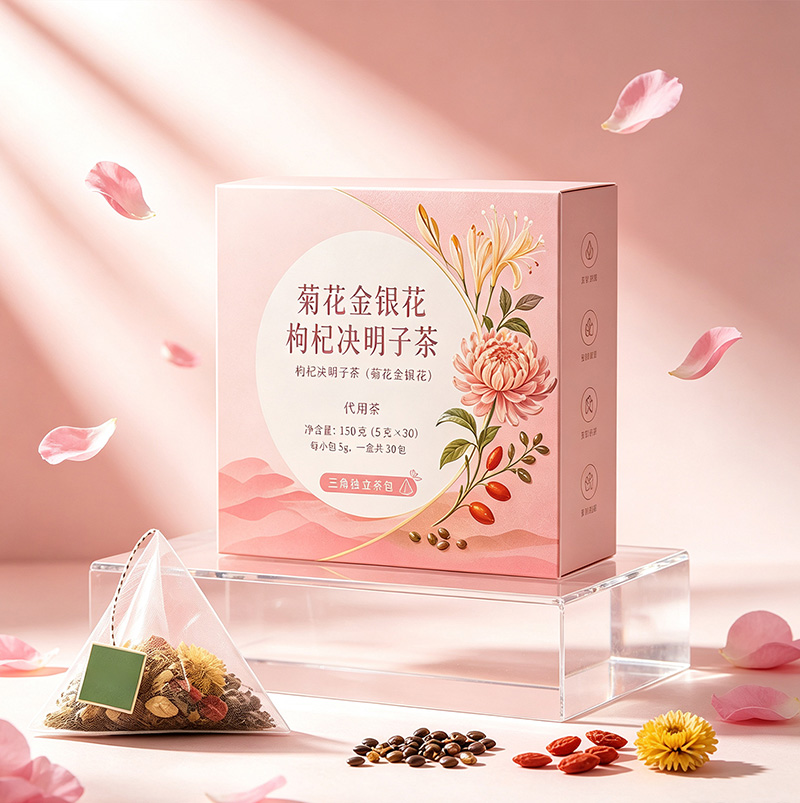
Particle size has to end up matched to the pack. Pyramid bags have generous volume and will take larger pieces and even whole flowers, which looks excellent on shelf, but they demand good uniformity. Flat filter bags have little room and suit cut or coarse crushed material best. Loose tea in a canister is relatively forgiving on size, though fines still need controlling to avoid stratification. If the product is positioned for cold brew, extraction is inherently slower, so either grind finer or state the cold brew time clearly, otherwise consumers following hot-brew habits end up with a weak cup. These interactions belong on the table at briefing stage. Once both the pack and the particle size are fixed, changing either moves tooling, filter media and process settings, and that costs far more than one extra review meeting.
Related Products
Grape Oolong Fruit Tea Blend | Pyramid Tea Bags Herbal Wellness Tea Custom OEM | Corn Silk Herbal Tea | Wellness Herbal Tea Private Label OEM Manufacturer
About Guangzhou Mesen Health Biotechnology Co., Ltd
Guangzhou Mesen Health Biotechnology Co., Ltd is located in the Huashan Science and Technology Park, Huadu District, Guangzhou. The company has focused on OEM and ODM services for the big health industry for nearly 20 years, operating dedicated research, production, sales and management centres, and maintaining long-term strategic partnerships with well-known Chinese medicine colleges and research institutions. Capabilities span pressed candy, gummies, capsules, solid beverages, herbal teas, plant beverages, protein powders, dietary supplements and enzyme jelly - from formulation development through contract manufacturing. For details on minimum order quantities, sampling lead times and quotations, see our manufacturing advantages and product range, or contact us for a tailored proposal.
Further Reading